Marketing Funnels: How to Turn Attention Into Customers
Wednesday, June 03, 2026

If a potential customer discovers your business today, what happens next?
Pause there for a second. Not what do you hope happens. Not what your homepage says. Not what your business card, Instagram bio, ad, or referral partner points to. What actually happens?
- If they are ready now, can they act easily?
- If they are not ready, can you follow up?
- If they leave, can you bring them back?
Where is the path?
These questions are uncomfortable because most small business owners are not short on effort. They are posting, networking, paying for ads, answering messages, asking for referrals, and sending people to a website. The activity is there. The energy is there. The problem is often that the system is not.
A person sees your post. They click your profile. They visit your website. They scan your services. They get distracted.
They tell themselves they will come back later. Then they disappear.
No booking. No inquiry. No sale.
That does not always mean they were not interested. Sometimes it means they were interested, but the next step was not clear enough. That is the job of Marketing Funnels: to turn attention into a guided decision path.
The Real Problem Is Usually Not Traffic
Many small businesses assume they need more traffic first. More clicks. More followers. More ad spend. More website visitors.
Sometimes that is true. But often, the bigger issue is not traffic. It is the lack of a path.
Many businesses are active, but they are not systematic. They have social posts, paid ads, referrals, networking, and a generic website, but people still leave with no next step.
Attention only becomes valuable when it has somewhere to go.
That line matters because attention is expensive. Even when you do not pay for it directly, you pay for it with time, consistency, content, networking, and reputation. If someone finally notices your business, the last thing you want is to make them work too hard to figure out what to do next.
A funnel gives that attention a clear purpose.

What Is a Marketing Funnel?
A marketing funnel is a simple path that helps someone take the next step with your business.
A person sees your ad, post, or message. They click. They go to a page. They receive one clear offer. Then they choose what to do next. A funnel does not give people many choices at once. It gives them one easy step at a time.
That path might look like this:
A person sees your post about a problem they have. They click to get a free guide. They enter their name and email. They receive helpful follow-up emails. They start to trust you. Later, they book a call or buy from you.
That is a funnel.
It helps strangers become leads. It helps leads become customers.
A website lets people look around. A funnel shows people the next useful step.
Website vs. Funnel: Why You Need Both
A website is still important. It gives people a place to learn about your company, review your services, check your credibility, read your content, and understand your brand.
The problem begins when the website is expected to do every job.
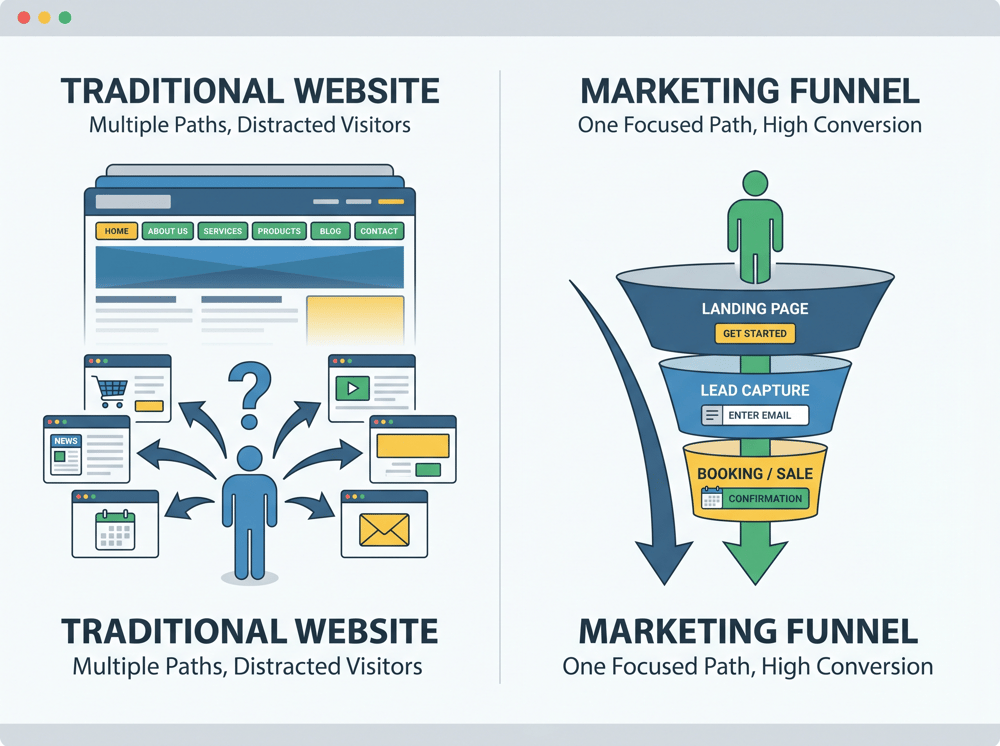
Most websites are built like digital brochures. They explain who you are, what you do, and why people should trust you. That is valuable. But a typical website also gives visitors many choices: Home, About, Services, Blog, Contact, Gallery, social media links, multiple service pages, and multiple calls to action.
More choices can create more hesitation, and when visitors do not know what to do next, they often leave.
A funnel has a different job.
Your website is your digital storefront. Your funnel is your guided conversion path. The storefront builds credibility. The funnel helps a prospect move toward a clear decision.
The website informs. The funnel guides action.
The website gives people room to explore. The funnel helps them move through one specific decision.
The website supports your brand. The funnel creates momentum.
So the answer is not to replace your website. The better answer is to add a funnel that works alongside it. Both are useful, but they do different jobs. The website is built to inform, while the funnel is built to convert. The website has many pages and many options. The funnel has a focused path and one obvious next step.
What a Funnel Does Differently
A funnel removes distractions and gives every visitor one focused next step.
A simple funnel path may look like this:
Ad or post → landing page → lead capture → follow-up → call or sale
That is the shift.
A website may ask someone to browse. A funnel asks them to take the next useful step.
That step could be:
- Download a guide
- Book a consultation
- Register for a webinar
- Request a quote
- Complete an assessment
- Buy a starter offer
- Apply for a service
A good funnel answers one practical question: what is the best next step this person can take right now?
That question keeps the experience focused. It also makes the customer journey easier for the person on the other side of the screen.
The Anatomy of a Simple Funnel
A funnel is not just a page. It is a guided customer journey.
A simple funnel has several strategic pieces: audience, problem, promise, offer, follow-up, and sale.
Each piece answers a question.
- Who is this for?
- What pain do they feel?
- What result do you offer?
- What is the next step?
- How do you build trust?
- How do they become a customer?
This is why a funnel works best when it is specific.
A generic message like “we help small businesses grow” is hard to act on. A specific message like “download the 10-point checklist to fix the leaks in your booking process” gives the right person a clear reason to take action.
The more focused the funnel, the easier it becomes to match the message, page, offer, and follow-up.
A useful starting point is simple: one audience, one problem, one offer, one path.

Why Funnels Build Trust
Funnels work because people often need a low-pressure first step before they are ready for a bigger decision.
This matters because many prospects are not ready to buy the first time they discover you.
They may not know you yet. They may be comparing options. They may be aware of the problem but unsure what solution they need. They may need education before they feel confident enough to book or buy.
A funnel gives them a smaller first step.
The journey often happens through a series of decisions: click the ad or post, read the landing page, download the free resource, open the follow-up email, then book a call or request a quote.
Each step builds more trust, clarity, and confidence.
Low-pressure steps make bigger decisions easier.
That is the difference between pressure and guidance.
A weak funnel tries to force a sale too early. A strong funnel helps the person move at a pace that makes sense, while still giving them a clear direction.
Lead Funnel: Turning Interest Into Contact Information
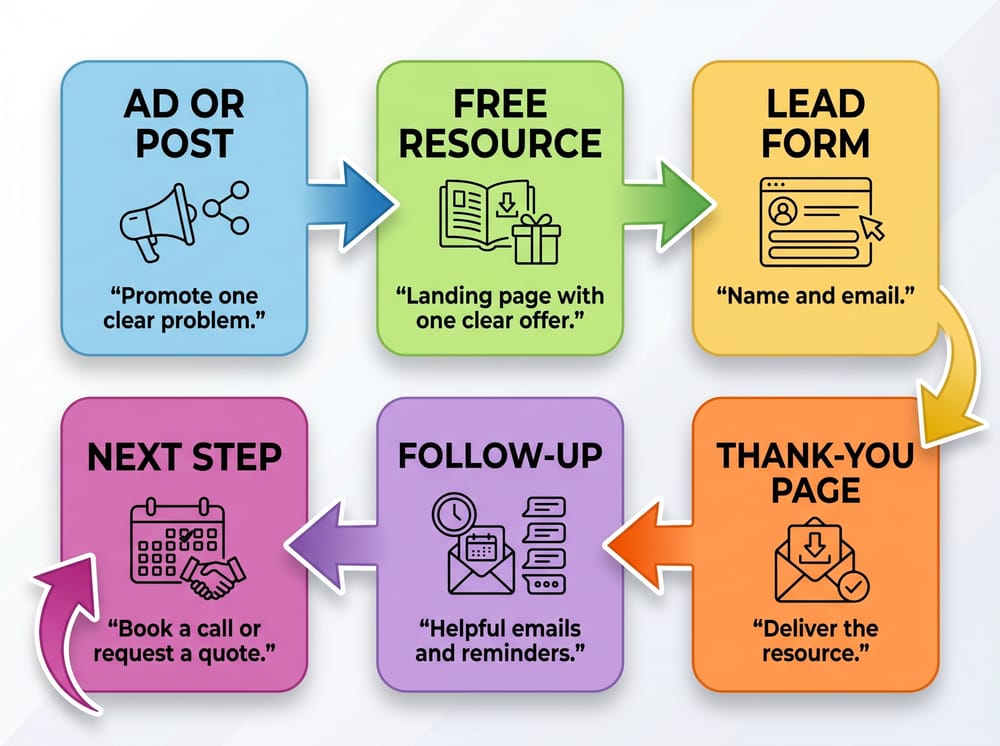
A lead funnel is designed to capture contact information from people who are interested but not ready to buy today.
This is one of the most useful funnel types for small businesses because many prospects need time. They may like what you do, but they are still comparing options, checking budgets, talking to a spouse or partner, waiting for the right moment, or trying to understand the problem better.
Without a lead funnel, they may visit your website and leave.
With a lead funnel, they can take a smaller first step.
A lead funnel often uses a lead magnet. This could be a checklist, guide, template, quiz, assessment, coupon, report, or short training. The visitor receives something useful. In exchange, they share their name, email, phone number, or another relevant detail.
A local service business could offer:
“Download the Homeowner’s Emergency Repair Checklist.”
A realtor could offer:
“Get the First-Time Buyer Preparation Guide.”
A clinic could offer:
“Take the 2-Minute Back Pain Assessment.”
The key is that the lead magnet should solve one clear problem for one clear audience.
After the person opts in, follow-up begins. That follow-up can include helpful emails, reminders, examples, education, proof, and an invitation to book, request a quote, or buy.
A lead funnel works because it turns anonymous interest into a relationship.
Webinar Funnel: Teaching Before Selling
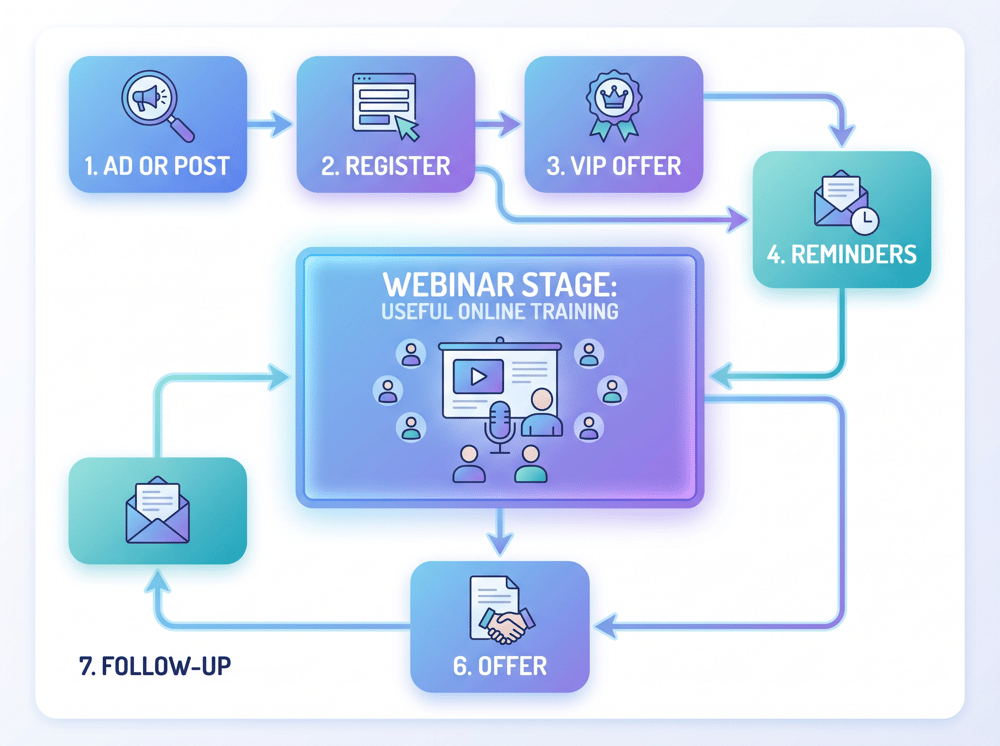
A webinar funnel is built around education.
It invites people to register for a training, attend the webinar, learn about a problem, understand a solution, and then consider a next step.
This type of funnel is useful when your product or service needs explanation. If people need to understand your process, trust your expertise, or see the value before buying, a webinar funnel can help.
A webinar funnel often follows this path:
Ad or post → registration page → confirmation page → reminders → webinar → offer → follow-up
The webinar itself should not be just a sales pitch. It should teach something useful. It should help people understand the problem, see what is possible, and feel more confident about the next step.
For example, a wellness provider might offer a training on simple daily habits for reducing stress and supporting energy. A business coach might teach a framework for improving sales calls. A financial consultant might explain common planning mistakes for a specific audience.
The offer comes after value has been delivered.
That is what makes the sales conversation feel natural. The prospect has already spent time with your ideas. They understand your approach. They are warmer than someone who only clicked on a generic service page.
Sales Funnel: Creating a Focused Buying Path

A sales funnel is built to move a person toward a purchase. It can be simple, or it can include multiple offers after the first sale.
The simplest version might present one product or service and lead the customer to checkout. A more developed sales funnel may include a front-end offer, an order bump, an upsell, a downsell, and follow-up.
The point is not to pressure people. The point is to present logical offers at the right moment.
For example, a small business might sell a starter product first. During checkout, it may offer a simple add-on that complements the purchase. After the purchase, it may present a higher-value bundle. If the customer says no, it may offer a smaller alternative.
This only works well when the offers make sense together.
A good sales funnel should feel helpful, not manipulative.
The first sale starts the relationship. The follow-up and offer sequence can grow the value of that relationship when the next offers are relevant, timely, and useful.
Tripwire Funnel: A Small First Purchase

A tripwire funnel is a type of front-end funnel built around a low-cost starter offer.
The purpose is to help someone become a customer with less hesitation.
A tripwire offer might be a mini audit, short workshop, sample product, starter kit, low-cost consultation, paid checklist, or introductory service.
The price is usually not the main point. The main point is reducing friction.
Once someone buys from you, the relationship changes. They are no longer only a lead. They are a customer. If the first experience is useful, they are more likely to consider the next offer.
A tripwire funnel can work well when the first offer naturally connects to a larger product or service.
For example:
- A marketing consultant offers a low-cost website conversion review. The next step could be a full funnel strategy.
- A fitness coach offers a paid seven-day meal plan. The next step could be a coaching package.
- A home service company offers a seasonal inspection. The next step could be a repair or maintenance plan.
The tripwire should not be random. It should be the first helpful step in a bigger journey.
Booking Funnel: Turning Interest Into Appointments

A booking funnel is designed to create appointments, consultations, calls, or quote requests.
For many small businesses, the goal is not an instant online sale. The goal is a call, appointment, consultation, quote request, assessment, or application.
That is where a booking funnel fits.
A booking funnel might look like this:
Ad or post → focused landing page → short form → calendar or consultation offer → reminders → booked appointment
This works especially well for local services, clinics, coaches, consultants, contractors, agencies, and professional service providers.
Imagine a local clinic that wants more qualified appointments for people dealing with back pain. Instead of sending everyone to a general homepage, the clinic uses a focused funnel.
- The ad speaks to one problem: back pain.
- The page offers one next step: a short assessment.
- The lead form collects the right information.
- The thank-you page invites the person to book.
- The follow-up emails provide helpful education and reminders.
- The message, page, and offer all match the same problem. That is why the journey feels clear.
Each funnel has a different job, but the goal is the same: help the right person take the right next step. Whether you want more leads, bookings, sales, or warmer prospects, the best funnel is the one that matches your customer’s stage and your business goal.

The Simple Funnel Framework
The best first funnel is usually not complicated.
Start with one audience.
Do not try to write for everyone. Choose a clear group of people with a shared problem. The more specific the audience, the easier the message becomes.
Choose one problem.
Pick a problem your audience already understands or feels. If they do not recognize the problem, they are less likely to act.
Create one valuable offer.
This could be a guide, webinar, checklist, assessment, consultation, quote, starter product, or booking opportunity. The offer should feel useful enough for the person to take the next step.
Build one focused page.
The landing page should match the message that brought the visitor there. It should explain the problem, show the value of the offer, and make the call to action easy to find.
Add follow-up and a clear CTA.
Follow-up is where many funnels become profitable. Not everyone acts immediately. Helpful reminders, education, proof, and next-step invitations keep the relationship alive.
One audience. One problem. One offer. One path.
That is enough to start.

Funnel Ideas for Small Businesses
- A local retailer can use a starter offer or VIP list.
- An agency can offer a marketing review.
- A clinic can use a short assessment funnel.
- A restaurant can create a catering inquiry funnel.
- A dental office can use a smile assessment.
- A consultant can offer a business audit.
- A coach can offer free training.
- A contractor can use an emergency repair quote funnel.
- A realtor can use a first-time buyer guide.
- A fitness studio can promote a trial class.
Any business that needs leads, bookings, quotes, appointments, inquiries, or sales can use a funnel.
The best funnel idea usually comes from listening to customers. What do they ask before buying? What worries them? What do they need to understand? What first step would feel helpful?
Build the funnel around that.
Common Funnel Mistakes to Avoid
A funnel is a system you test and improve, not just a page you publish once.
Common mistakes include selling too much too soon, sending everyone to one generic page, using too many calls to action, forgetting mobile users, having no follow-up sequence, building once and never improving, and making the offer unclear.
The better rule is simple: make the next step obvious, useful, and easy.
- If the visitor has to think too hard, the path is not clear enough.
- If the offer is vague, the path is not clear enough.
- If the follow-up stops after one message, the path is not complete enough.
- Funnels do not need to be aggressive. They need to be intentional.
Your Next Step: Find the Path
Look at your current marketing.
Your website. Your ads. Your social posts. Your referral process. Your business card. Your email signature. Your networking conversations.
- Where are people being sent?
- What are they being asked to do?
- What happens if they are ready now?
- What happens if they are not ready yet?
- What happens if they leave?
That final question deserves to sit on your desk for a while: where is the path?
Marketing Funnels help small businesses answer that question. They turn attention into leads, leads into bookings, and bookings or purchases into customer relationships. They do not replace your website. They give your marketing a clearer job.
Start with one audience, one problem, one offer, and one path.
The business with the clearest path usually wins.
Ready to Build a Funnel That Actually Moves People Forward?
If your marketing is getting attention but not enough leads, bookings, or sales, the missing piece may not be more traffic. It may be a clearer path.
A strong funnel helps the right people understand your offer, take the next step, and stay connected until they are ready to act. It gives your marketing structure, purpose, and follow-up, without making the customer journey feel pushy or complicated.
Need help creating a powerful funnel for your business? Contact us and let’s map the right funnel for your audience, your offer, and your goals. We’ll help you turn attention into action, and action into measurable business opportunities.
Marketing funnels for small businesses that need more booked calls, leads, and customers.