Funnels for Marketing: Why Funnels Convert Better Than websites
Saturday, March 14, 2026

Funnels in marketing are not a trend. They are a practical way to guide attention.
Most businesses already have a website. The site explains who you are, what you sell, and how to contact you. That is useful, but it is also broad. A website is designed to serve many audiences and many goals at once.
Funnels are different. A funnel is a focused path built around one outcome, like collecting an email address, booking a consultation, registering for a webinar, or making a purchase. You can still use your website for credibility and content, but funnels give you something a traditional site rarely delivers on its own: a clear sequence that moves one person toward one next step.
Funnels as a pattern interruption in traditional digital marketing
If you have been marketing online for any amount of time, you have seen what most audiences do by default: They click, skim, scroll, and bounce. They open a few tabs. They get distracted. They promise themselves they will come back later. They usually do not.
A pattern interrupt is a technique used to break someone’s expected flow so you can regain attention and re-engage them.

Funnels can act as a pattern interruption, not because they are loud, but because they are structured differently than the typical “browse our site” experience.
A traditional website behaves like a menu. It offers choices: services, about, blog, testimonials, contact, pricing, and more. Menus are great when someone already knows what they want. They are not as helpful when someone is still deciding.
Funnels behave like a guided path. They reduce the number of choices and present one decision at a time. That shift alone changes how people interact:
- A single-purpose landing page feels different than a homepage packed with navigation.
- A short quiz or assessment feels different from a generic “contact us” form.
- A webinar registration flow with reminders feels different than reading one blog post and leaving.
Why funnels convert better than traditional websites
It is not that “websites are bad.” It is that websites are not usually built to convert cold traffic into a specific action on a specific day.
Funnels often convert better for three main reasons: focus, intent matching, and follow-up.
1) Fewer choices, more focus
The biggest conversion killer on many websites is distraction. Navigation bars, footers, sidebars, unrelated CTAs, and multiple “paths” can pull attention away from the one action you care about.
Landing pages are often designed with the opposite philosophy: remove distractions, create clarity, and keep the visitor focused on a single goal. Landing pages aim to convert visitors and should not have navigation menus and unnecessary elements to keep attention on the offer.
A funnel leans into that principle. Instead of asking a visitor to decide between eight links, it asks one question:
“Do you want this next step, yes or no?”
2) They match the message to the intent
Funnels let you align each step with what the visitor expects next.
If your ad promises a checklist, the landing page delivers a checklist. If your YouTube video promises training, the next step is to register for the training. If your blog post teaches a method, the CTA offers the tool, template, or next action that makes sense for someone who has just learned that method.
This matters because a lot of “traditional” digital marketing breaks the promise-to-delivery loop. You run an ad, it goes to the homepage, and the visitor has to hunt for what they were promised. Even if the information exists somewhere, the extra effort is enough to lose them.
Funnels reduce that mismatch by design. Each step is written for one context and one audience temperature.
3) They keep working after the visit
Websites often rely on a one-session outcome. Someone visits, reads, then either converts or leaves.
Funnels typically provide a way to follow up early. That follow-up can be via email, SMS (where appropriate), retargeting, or a content sequence.
Even a simple email nurture sequence can turn “not today” into “yes next week,” because it keeps the conversation going.
What is a marketing funnel, really?
A marketing funnel is a way to map the customer journey from first awareness to conversion, and often into retention and repeat business.
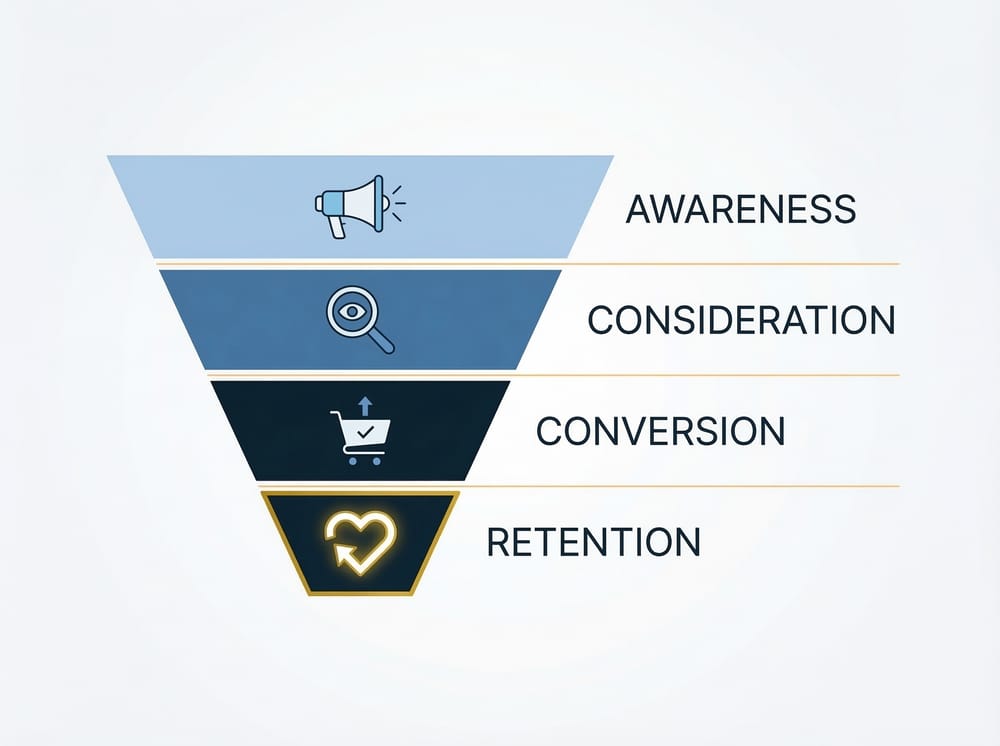
Most funnels, regardless of name, use the same building blocks.
The building blocks most funnels share:
Traffic (discovery)
SEO content, social media, paid ads, partnerships, referrals, affiliate traffic, or direct outreach.
A micro-commitment (opt-in or action)
This could be a lead magnet signup, a quiz completion, a webinar registration, or a low-cost purchase.
Nurture (trust and objection handling)
Email sequences, retargeting ads, case studies, short video series, FAQs, or community touchpoints.
Conversion event
A purchase, a booked call, an application, a demo request, or a paid trial.
Retention (post-conversion experience)
Onboarding emails, usage tips, support, customer success touchpoints, cross-sells, and reactivation campaigns.
When you look at funnels through this lens, the “type” becomes less mysterious. The type is just the strategy you use for the micro-commitment and the conversion event.
Common funnel types (and when to use each)
Sales Funnel
A Sales Funnel is the classic model for how people move from awareness to purchase. Sales funnel stages help you understand and manage the path to purchase.
A Sales Funnel also helps to increase cart value by offering upsell options within the same flow.
Best for:
- E-commerce stores selling products directly.
- Digital products with a clear value proposition
- Simple service offers with transparent packages
Typical flow:
Content or ads → landing page → offer page → upsell / downsell page → confirmation and onboarding.
Lead Funnels
Lead Funnels prioritize capturing contact information and building a relationship before the sale.

Best for:
- Service businesses (agencies, consultants, local services)
- B2B products with longer sales cycles
- High-consideration purchases where trust matters
Typical flow:
Lead magnet → thank-you page → nurture emails → call booking or demo request.
Lead magnet ideas that fit the funnel:
- A checklist that solves one urgent pain
- A short quiz that segments the audience
- A template that makes a task faster
- A “starter plan” that shows your method
Lead funnels convert better when the opt-in matches the next step. If your next step is a strategy call, an “industry trends report” may attract curious readers but not buyers. A “costly mistakes checklist” or “ROI calculator” often pulls in people who are actively evaluating.
Tripwire Funnel
A Tripwire Funnel uses a low-priced, high-value introductory offer to quickly turn a prospect into a buyer.

Best for:
- E-commerce brands that can offer a starter product
- Creators selling templates, mini-courses, or workshops
- Coaches who have an entry product that builds trust
Typical flow:
Free opt-in (optional) → tripwire offer → upsell → core offer → nurture and retention
Why it works:
Buying changes the relationship. Someone who spends even a small amount is more likely to open emails, take the next step, and trust the value of your paid offers.
Common mistakes:
- Making the tripwire too generic. It should solve a real problem, not feel like a random discounted item.
- Breaking the value ladder. The tripwire should naturally lead into the main offer rather than exist in isolation.
Webinar Funnel
A Webinar Funnel uses a webinar (live or automated) to educate, build trust, and present an offer.
Best for:
- Offers that require education or belief change
- Buyers who need to understand a framework before committing
- Services and software where the “how it works” matters
Typical flow:
Registration page → confirmation page → reminders → webinar → offer → follow-up sequence
Where webinar funnels win:
Webinars create concentrated attention. A visitor might give you 45 seconds on a website. A registrant might give you 30 to 60 minutes in a webinar environment, especially if the topic is urgent and specific.
How to make it feel like a pattern interrupt:
- Open with a clear promise and a quick win.
- Use a simple structure: problem, stakes, method, proof, next step.
- Keep the offer aligned with the method you just taught.
Book Funnels
Book Funnels lead with a book offer (print or digital) and then add structured upsells. A book funnel is a funnel used to promote a book or an ebook with guided steps and upsells.
Best for:
- Authors building an audience
- Experts who want credibility in a physical format
- Consultants whose book pre-sells their method
Typical flow:
Book offer → order bump (optional) → upsell (course, workshop, bundle) → thank-you page → nurture → consultation or core offer
Why book funnels work:
A book can be a tangible trust-builder. It is also a self-qualifier. People who read are more likely to engage deeply with your ideas, which can make later offers feel like a natural continuation rather than a cold pitch.
Practical tip:
Treat the book as the start of the relationship, not the end goal. The follow-up sequence matters. If the book is the only step, you often leave a lot of value on the table.
High-Ticket Funnel
A High-Ticket Funnel is built to sell premium offers, usually with qualification and a sales conversation. High-ticket digital marketing is a promotion for premium offerings aimed at high-spending prospects.

Best for:
- Coaching, consulting, and done-for-you services
- Agencies and B2B services
- Premium programs with limited capacity
Why it converts (and who it filters out):
High-ticket funnels are not built for maximum volume. They are built for fit. The application and call steps help qualify prospects so you spend time with people who have the budget, need, and urgency.
What improves conversion here:
- Clear positioning: who it is for and who it is not for
- Proof that matches the prospect’s situation (relevant case studies)
- A clean handoff: application to call scheduling without friction
How to choose the right funnel for your business
If you pick a funnel type that doesn't align with your offer, the funnel will feel expensive and frustrating. If the type matches your offer, the funnel often feels obvious.
Use these quick filters:
Choose based on price and trust
- Low price, fast decision: Sales Funnel or Tripwire Funnel
- Medium price, needs explanation: Webinar Funnel
- High price, needs qualification and trust: High-Ticket Funnel
Choose based on sales process
- No call needed: Sales Funnel, Tripwire Funnel, Book Funnels
- Call or demo needed: Lead Funnels feeding into a High-Ticket Funnel
Choose based on the audience temperature
- Cold traffic: Start with Lead Funnels or Webinar Funnel
- Warm audience: Sales Funnel or Tripwire Funnel can work well
- Existing audience: Book Funnels and high-ticket pathways can scale trust quickly
Funnels convert better when they are treated like systems you refine, not assets you launch once.
Conclusion:
Funnels in marketing work because they respect how people actually behave online. Most visitors are distracted, cautious, and not ready to buy on the first click.
A funnel interrupts that default browsing pattern by removing noise, matching the message to the moment, and guiding prospects through one clear decision at a time. Whether you are using Lead Funnels, a Webinar Funnel, Book Funnels, a Tripwire Funnel, a classic Sales Funnel, or a High-Ticket Funnel, the advantage is the same: less friction, more clarity, and a follow-up system that keeps the conversation going after the visit.
Ready to start using funnels to boost your business conversions?
BeaverRo Digital helps you turn traffic into real revenue with funnels built around your offer, your audience, and your growth goals.
Whether you need Lead Funnels, a high-converting Sales Funnel, a Webinar Funnel, Book Funnels, a Tripwire Funnel, or a High-Ticket Funnel, we build the entire system end to end, including landing pages, automation, and follow-up sequences. No more hoping people click around your website. You get a clear path that captures leads, nurtures them, and converts them into customers.
Marketing funnels for small businesses that need more booked calls, leads, and customers.